'%3e%3cpath%20fill='%23000'%20d='M0%2019.673V0h3.813v16.503h10.192v3.17zm29.307-7.815v.766c0%204.126-3%207.378-7.002%207.378h-.54c-4.002%200-7.002-3.252-7.002-7.378v-.766c0-4.153%203-7.378%207.002-7.378h.54c4.002%200%207.002%203.225%207.002%207.378m-3.676.493v-.22c0-3.06-1.243-4.78-3.596-4.78s-3.596%201.721-3.596%204.78v.22c0%203.033%201.243%204.78%203.596%204.78s3.596-1.748%203.596-4.78M36.31%207.678v7.788c0%201.038.323%201.339%201.433%201.339h1.622v2.868h-2.568c-3.082%200-4.19-1.148-4.19-4.207V7.678h-2.353V4.81h2.353V.874h3.704V4.81h3.056v2.868zm5.162%2011.995V0h3.678v19.673zm6.705-16.366V0h3.678v3.307zm0%2016.366V4.809h3.678v14.864zm6.705%200V4.81h3.678v1.558c.946-1.176%202.353-1.886%204.083-1.886h.54c3.353%200%205.409%202.132%205.409%205.74v9.453h-3.678v-9.402c0-1.939-1.081-2.924-3.19-2.924-1.974%200-3.164.983-3.164%203.034v9.29z'/%3e%3cpath%20fill='%23f41424'%20d='M74.238%204.81h-4.11l5.003%206.966-5.112%207.897h3.975l5.039-7.933z'/%3e%3cpath%20fill='%23000'%20d='m80.94%2010.396%203.95-5.586h-3.974l-1.934%202.757%201.957%202.829Zm-.048%202.884-2.013%203.173%202.011%203.22H85z'/%3e%3c/g%3e%3cdefs%3e%3cclipPath%20id='a'%3e%3cpath%20fill='%23fff'%20d='M0%200h85v20H0z'/%3e%3c/clipPath%3e%3c/defs%3e%3c/svg%3e)
Lotlinx Q1 2026 Vincensus Report Reveals a Market in Motion: Demand Has Not Disappeared – It Has Moved
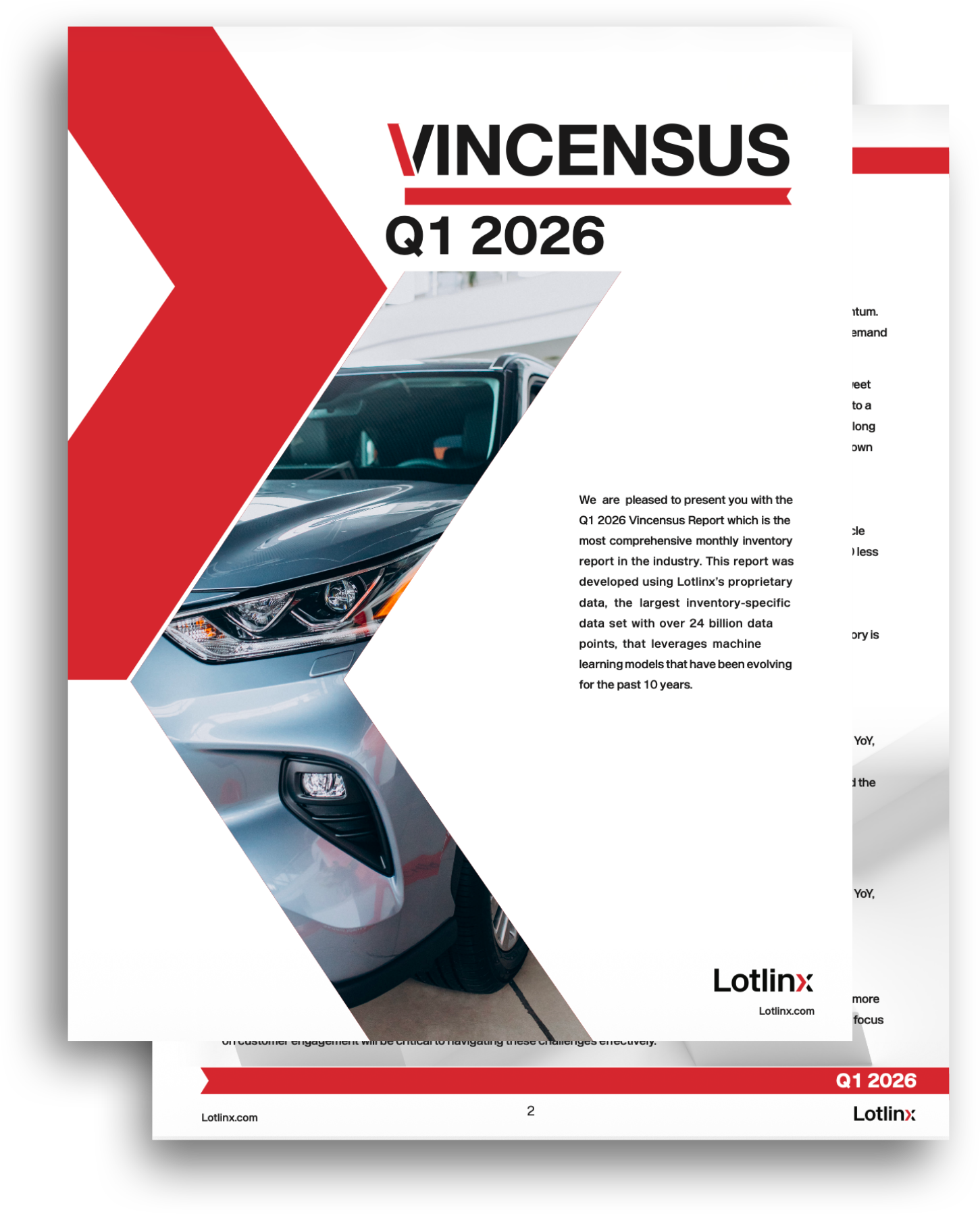
New Vehicle Prices Hit $45,926 as Used Vehicles Surge 8%; EV Inventory Swells to 100-Day Supply While Hybrid Sales Capture a Quarter of the Market
DETROIT (April 23, 2026) — Lotlinx (opens in a new tab), the auto industry’s first and only VIN Performance platform built to help dealers maximize profitability, today released its Q1 2026 Vincensus Report, the most comprehensive quarterly inventory analysis in the industry. Leveraging over 24 billion proprietary, VIN-level data points and more than a decade of machine learning innovation, the report delivers a clear-eyed view of an automotive market under significant pressure, and a road map for dealers who want to compete in it. Click here to access the full Q1 Quarterly Vincensus Report. (opens in a new tab)
The New Vehicle Market: Rising Prices, Rising Inventory, Slowing Sales
New vehicle sales fell 7% quarter over quarter in Q1 2026, landing slightly below the same period last year, according to Vincensus data. The average listing price on new units climbed to $45,926, a 3% increase from Q4 2025 and a 2% increase year-over-year, while the average last listed price of sold units held relatively steady at $44,175.
That price gap matters. It reflects an intensifying affordability ceiling that is pushing buyers toward the exits of the new car market. When average listing prices rise faster than transaction prices, it signals that dealers are increasingly having to discount to close deals. Indeed, 26% of new vehicle sales in Q1 involved a markdown, with an average price reduction of 5%.
New vehicle day supply increased to 69 days, up two days from Q4 2025 and six days higher than a year ago, while total new inventory levels ended the quarter 18% above where they stood last year. Nearly half (48%) of new vehicles on dealer lots had been sitting for more than 45 days as of March 31.
As tariffs on imported vehicles and components added an estimated $30 billion in costs to the automotive industry over the past year, and as automakers incorporated those costs into 2026 model year pricing, the affordability ceiling for the average consumer has moved materially lower. Dealers absorbing 4.5% of those price increases themselves face shrinking front-end margins precisely when carrying costs are rising.
The strategic response is not to simply hold on. It is to actively manage what is on the lot, price competitively, and reduce aged inventory before it becomes a larger liability. A striking 55% of new vehicle listings received zero vehicle detail page views on any given day, a 7% increase year over year. Invisible inventory costs money without generating pipeline.
The Used Vehicle Opportunity: Fast-Moving, Affordable, and Growing
If the new market is the cautionary tale of Q1, the used market is the clear opportunity. Used vehicle sales grew 8% quarter over quarter and are running ahead of last year, even as new sales declined. Used vehicles carried an average listing price of $29,374, more than $16,500 below the average new vehicle, and those vehicles are turning nearly twice as fast, operating at a lean 38-day supply (down 6 days from Q4 2025 and in line with the same quarter a year ago).
The used market’s aged inventory also improved, with aged ending inventory decreasing to 42%, down 10% quarter over quarter. Consumer demand for used vehicles jumped 14% quarter over quarter, representing one of the strongest demand signals in the report.
For dealers, this is both an opportunity and a challenge. Used vehicle acquisition strategy, pricing discipline, and digital visibility need to be elevated priorities right now. Lotlinx data shows that Lotlinx customers carried 5% less aged used inventory than the broader market in Q1, a meaningful competitive advantage in a market where carrying days translate directly to carrying costs. Used vehicle pricing is also climbing, with average listing prices up 7% quarter over quarter and 5% year over year. Dealers who source inventory smartly and price it competitively are well-positioned to capture a buyer base that is actively searching for value.
The Markdown Stats: Discounting Is Not a Strategy, It Is a Warning Sign
- 26% of new vehicle sales in Q1 involved a markdown, with an average price reduction of 5%, unchanged quarter over quarter.
- Brands carrying bloated new inventory, particularly in EV and lower-demand sedan categories, are posting the highest markdown rates; lean brands like Lexus and Toyota are moving units with minimal discounting.
- In a tariff-elevated pricing environment where new MSRPs are already stretched, markdown-driven selling compresses margins at both ends. The path forward is faster turns, not deeper cuts.
EVs vs. Hybrids: A Market at a Crossroads
- EV market share fell to 6.3% in Q1, down 1.4 percentage points year over year, following the expiration of federal consumer tax credits at the end of Q3 2025.
- New EV inventory hit a 100-day supply — up 28 days year over year — while sold EV unit prices dropped 12% quarter over quarter to $49,057.
- Hybrids captured 25% of all new vehicle Q1 sales, with inventory surging 23% quarter over quarter and 40% year over year as OEMs and dealers responded to clear consumer demand.
Click here to download the Q1 Quarterly Vincensus Report. (opens in a new tab)
About Lotlinx
Founded in 2012 and headquartered in Peterborough, New Hampshire, Lotlinx is the automotive industry’s leading VIN performance platform. Purpose-built for dealers, Lotlinx uses advanced AI and the industry’s most robust VIN and shopper behavior data to help dealers predict risk, optimize pricing and promotion, and improve merchandising – all at the individual vehicle level. By delivering real-time, VIN-specific insights and actions, Lotlinx empowers dealers and OEMS to take full control of their inventory and maximize profit, one VIN at a time. Learn more at www.lotlinx.com.
Share this post: